


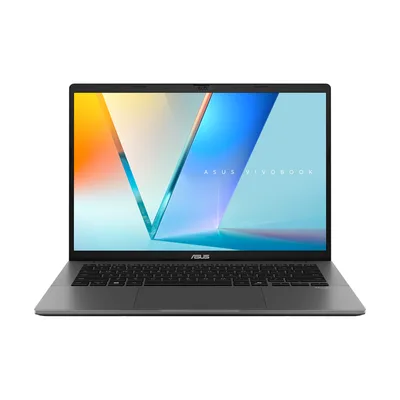
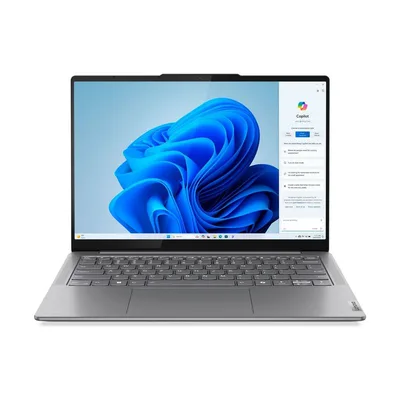
ASUS Vivobook OLED (M3407) vs Lenovo Yoga Slim 7 14 (Intel)
For most people, the Vivobook OLED is the one to get. Its battery lasts longer, it has more memory and it has more storage. The Yoga Slim 7 14 makes more sense if you often work near a window or outdoors.
We earn a commission from qualifying Amazon purchases made through our links, at no extra cost to you. This never affects our specs. How we make money.
Key differences
- Battery life Vivobook OLED wins
The Vivobook OLED is rated for 25 hours on a charge and the Yoga Slim 7 14 for 20.8. Real use drains both faster than the rating, so read the gap as a rough guide.
- Memory Vivobook OLED wins
The Vivobook OLED has 32 GB of memory, while the Yoga Slim 7 14 has 16 GB. That helps when you keep many apps, tabs or big projects open.
- Storage Vivobook OLED wins
The Vivobook OLED has a 1 TB drive, while the Yoga Slim 7 14 has 512 GB. The bigger drive holds far more photos, music and games before you have to clear space.
- Brightness Yoga Slim 7 14 wins
The Yoga Slim 7 14 has the brighter screen, 400 nits against 300, so it's easier to read near a window or on a train.
- Ports Yoga Slim 7 14 wins
Only the Yoga Slim 7 14 has Thunderbolt or USB4, so you can use 40 Gbps docks that run several screens and fast external drives.
- HDR Yoga Slim 7 14 wins
The Yoga Slim 7 14 has a screen with an HDR certificate, so films and games show brighter highlights and deeper shadows. The Vivobook OLED doesn't support HDR.
Which one should you choose?
Choose the Vivobook OLED if…
- you work away from a socket for long stretches
- you keep lots of apps and tabs open
- you keep a big photo, music or game library on the laptop
- you want Windows' newest AI features to run smoothly
Choose the Yoga Slim 7 14 if…
- you often work near a window or outdoors
- you use a dock or fast external drives
- you watch a lot of films or series
Full spec comparison
Both run Windows and have OLED screens, so the choice comes down to the details. The real differences are battery life, memory and storage.
Green cells with a ✓ mark the better spec in that row. Tick "Show differences only" to hide the rows where they match.
Performance
The Vivobook OLED has a much faster built-in AI chip, which speeds up Windows features like live captions, background blur and on-device AI tools.
| Spec | ASUS Vivobook OLED (M3407) | Lenovo Yoga Slim 7 14 (Intel) |
|---|---|---|
| Processor | AMD Ryzen AI 7 445 | Intel Core Ultra 5 125H |
| Graphics | AMD Radeon Graphics | Intel Arc Graphics |
| AI engine (NPU) | 50 TOPS | 11 TOPS |
| Memory (RAM) | 32 GB | 16 GB |
| Memory type | DDR5 | LPDDR5X-7467 |
| Maximum memory | 32 GB | 16 GB |
| Memory upgrades | Partly upgradeable | Soldered (not upgradeable) |
| Storage | 1 TB | 512 GB |
| Storage type | SSD | SSD |
| Storage interface | PCIe 4.0 NVMe M.2 2280 | PCIe 4.0 x4 NVMe M.2 2242 |
| Storage slots | 1 | 1 |
Screen
| Spec | ASUS Vivobook OLED (M3407) | Lenovo Yoga Slim 7 14 (Intel) |
|---|---|---|
| Screen size | 14" | 14" |
| Resolution | Full HD+ (1920 x 1200) | Full HD+ (1920 x 1200) |
| Aspect ratio | 16:10 | 16:10 |
| Panel | OLED | OLED |
| Refresh rate | 60 Hz | 60 Hz |
| Variable refresh (VRR) | No | — |
| Brightness | 300 nits | 400 nits |
| Colour range | 95% DCI-P3 | 100% DCI-P3 |
| HDR | None | VESA DisplayHDR True Black 500 |
| Finish | — | Glossy |
| Touchscreen | No | No |
Battery and size
| Spec | ASUS Vivobook OLED (M3407) | Lenovo Yoga Slim 7 14 (Intel) |
|---|---|---|
| Battery life (maker claim) | Up to 25 hours | Up to 20.8 hours |
| Battery capacity | 70 Wh | 65 Wh |
| Charger | 65 W | 65 W |
| Charges via | USB-C | USB-C |
| Fast charging | — | Rapid Charge Boost: 2 hours of runtime from a 15-minute charge |
| Weight | 1.4 kg | 1.39 kg |
| Dimensions | 315.2 x 223.4 x 15.9-17.9 mm | 312 x 221 x 14.9 mm |
| Materials | — | Aluminium (top), aluminium (bottom) |
| Durability | US military-grade durability | MIL-STD-810H |
| Colour | Matte Gray | Luna Grey |
| Colours available | Matte Gray | Luna Grey |
Ports and wireless
The Yoga Slim 7 14 has Wi-Fi 6E, the Vivobook OLED Wi-Fi 6. The newer standard gets more out of a modern router.
| Spec | ASUS Vivobook OLED (M3407) | Lenovo Yoga Slim 7 14 (Intel) |
|---|---|---|
| Ports | 2x USB-C 3.2 Gen 1 (charging, DisplayPort), 2x USB-A 3.2 Gen 1, 1x HDMI 2.1 TMDS, 1x 3.5 mm audio | 1x USB-A (USB 5Gbps, always on), 2x Thunderbolt 4 (USB-C, charging with USB PD 45-65W, DisplayPort 1.4), 1x HDMI 2.1 (up to 4K/60Hz), 1x 3.5 mm headphone/microphone combo jack |
| Thunderbolt / USB4 | None | Thunderbolt 4 |
| External displays (max) | — | 3 |
| Card reader | None | None |
| Ethernet | None | None |
| Wi-Fi | Wi-Fi 6 | Wi-Fi 6E |
| Bluetooth | Bluetooth 5.4 | Bluetooth 5.3 |
| Mobile data | None | None |
Features
| Spec | ASUS Vivobook OLED (M3407) | Lenovo Yoga Slim 7 14 (Intel) |
|---|---|---|
| Webcam | 1080p + IR | 1080p + IR |
| Webcam privacy | physical shutter | electronic shutter (E-shutter) |
| Backlit keyboard | Yes | Yes |
| Keyboard | backlit chiclet, 1.7 mm key travel | 6-row, multimedia Fn keys, 1.5 mm key travel, Copilot key, LED backlight |
| Login | Face | Face |
| Number pad | No | No |
| Touchpad | precision touchpad | Buttonless glass surface multi-touch touchpad, Precision TouchPad, 75 x 120 mm |
| Speakers | built-in speakers, Dolby Atmos | Stereo, 4x 2 W, Dolby Atmos, amplifier |
| Microphones | built-in array microphone | quad-microphone array |
| Pen | No | No |
| Security | Microsoft Pluton | Firmware TPM 2.0, E-shutter, IR camera for Windows Hello, BIOS passwords (administrator, user, hard disk), Self-healing BIOS |
Software and model
The Vivobook OLED came out in 2026, the Yoga Slim 7 14 in 2024. Newer models usually get software and security updates for longer.
| Spec | ASUS Vivobook OLED (M3407) | Lenovo Yoga Slim 7 14 (Intel) |
|---|---|---|
| Operating system | Windows 11 Home | Windows 11 Home |
| Model number | M3407GA-SF003W | 83CV0036UK |
| Released | 2026 | 2024 |